
Tu B’Shvat is a Jewish holiday which takes place on the 15th day of the Hebrew month of Shevat (corresponding to January / February in the Gregorian calendar). It is also called Rosh HaShanah La’Ilanot literally ‘New Year of the Trees’. In contemporary Israel, the day is celebrated as an ecological awareness day, and trees are planted in celebration.
Rhodes gradually developed into a very important Sephardi centre. With so many scholars, outstanding rabbis and authors’, it was often referred to as “La Chica Yerushalayim“, or “the small Jerusalem”. Under Ottoman rule which lasted until 1912, the Jews of Rhodes thrived and prospered, developing a distinct sub-culture rich in tradition.
Meaning and Significance
Contents
History
Traditionally, Tu B’Shvat was not a Jewish festival. Rather, it marked an important date for Jewish farmers in ancient times. The Torah states, “When you enter the land [of Israel] and plant any tree for food, you shall regard its fruit as forbidden. Three years it shall be forbidden for you, not to be eaten” (Leviticus 19:23). The fruit of the fourth year was to be offered to the priests in the Temple as a gift of gratitude for the bounty of the land, and the fifth-year fruit–and all subsequent fruit–was finally for the farmer. This law, however, raised the question of how farmers were to mark the “birthday” of a tree. The Rabbis therefore established the 15th of the month of Shevat as a general “birthday” for all trees, regardless of when they were actually planted.
Fruit trees were awarded special status in the Torah because of their importance in sustaining life and as a symbol of God’s divine favour. Even during times of war, God warns the Israelites, “When in your war against a city you have to besiege it a long time in order to capture it, you must not destroy its trees…”
How Tu B’Shavat was Celebrated in Rhodes
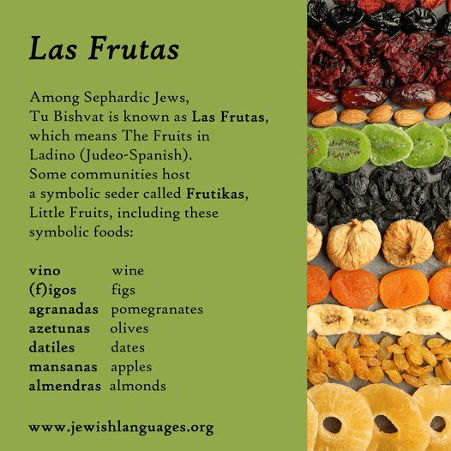
This festival is particularly important to the Sephardim and involves a ritual meal called Las Frutas (The Fruits). This was created by Jewish mystics in the 16th century, where four categories of fruit are served in successive courses, each accompanied by a glass of wine representing the different seasons. On this festival an abundance of sweet treats, including halva and marzipan, are offered.
It was the custom to exchange platters throughout the community. The platters used to hold a glass of wine or water and sweets such as masapán or fruit, either an orange or melon, or abo-dargho (fish roe). The children were bearers of the exchange. The children would carry a little hand-made satchel called “tallega” around their neck. As they stopped at each home, they would be given a treat of some kind of sweets, which they would accumulate in their satchel.
A wish would be expressed to the recipient: Ke bivas komo la agwa, ke tengas yena tu kasa, komo la portugal, meaning “May you live as abundantly as running water, may your home and possessions be plentiful as this sweet round orange”.
Ladino song for the holiday – Arvoles Yoran Por Luvia
Arvoles yoran por luvias
montanyas por ayres
Ansí lloran mis ojos
por ti querido amante
Lloro y digo qué va a ser de mí
En tierras ajenas me vo murirBlanca sos, blanca vistes
blanca la tu figura
Blancas flores caen de ti
De la tu hermozura
Lloro y digo …Deshojar quero una roza
y hacerme un vestido
Para irme a pasear con ti
mi querido
Lloro y digo …
Enfrente de mi hay un angelo
con tus ojos me mira
llorar quero y no puedo
mi corazón suspira
Lloro y digo …
Trees cry for rain
And mountains for air
That is how my eyes weep
For you, beloved
I weep and ask what will become of me
In a far away land I shall dieYou’re fair-skinned, you dress in white
Fair is your face
White flowers fall from you
From your beauty.
I weep …I wish to depetal a rose
And make a garment for myself
In order to go with you,
My dear.
I weep …
There is an angel in front of me
With your eyes he looks at me
I want to cry, but cannot
My heart sighs
I weep …
Arvoles yoran por luvias
montanyas por ayres
Ansí lloran mis ojos
por ti querido amante
Lloro y digo qué va a ser de mí
En tierras ajenas me vo murirBlanca sos, blanca vistes
blanca la tu figura
Blancas flores caen de ti
De la tu hermozura
Lloro y digo …Deshojar quero una roza
y hacerme un vestido
Para irme a pasear con ti
mi querido
Lloro y digo …
Enfrente de mi hay un angelo
con tus ojos me mira
llorar quero y no puedo
mi corazón suspira
Lloro y digo …
Trees cry for rain
And mountains for air
That is how my eyes weep
For you, beloved
I weep and ask what will become of me
In a far away land I shall dieYou’re fair-skinned, you dress in white
Fair is your face
White flowers fall from you
From your beauty.
I weep …I wish to depetal a rose
And make a garment for myself
In order to go with you,
My dear.
I weep …
There is an angel in front of me
With your eyes he looks at me
I want to cry, but cannot
My heart sighs
I weep …
Additional Resources
Complas Para Noche De Frutas
Ladino text and translation into English
A poem/song for Tu B’Shevat (Hamisha Aser B’Shevat) by Jehuda Kalazh (as noted in the final verse).
The Surprising Sephardi Significance of Tu BeShvat
The American Sephardi Federation
Virtual Sephardi Seder Tu Bisvhat 5781
YouTube Channel: Jewish Unity Through Diversity Institute
Sephardi Tu B’Shvat seder in Hebrew, Ladino and English
Las Frutas (Frutikas)
FRUTIKAS ṬU BISHEVAṬ SEDER
Sephardi Brotherhood of America
Complas Para Noche De Frutas
Ladino text and translation into English
A poem/song for Tu B’Shevat (Hamisha Aser B’Shevat) by Jehuda Kalazh (as noted in the final verse).
The Surprising Sephardi Significance of Tu BeShvat
The American Sephardi Federation
Virtual Sephardi Seder Tu Bisvhat 5781
YouTube Channel: Jewish Unity Through Diversity Institute
Sephardi Tu B’Shvat seder in Hebrew, Ladino and English
Las Frutas (Frutikas)
FRUTIKAS ṬU BISHEVAṬ SEDER
Sephardi Brotherhood of America
Sources and References
- Rebecca Amato Levy, I Remember Rhodes (1987).
- Elsie Menasce, The Sephardi Culinary Tradition (1984).
- Stella Cohen, Stella’s Sephardic Table (2012).