
In traditional Judaism, marriage is viewed as a contractual bond commanded by God in which a Jewish man and a Jewish woman come together to create a relationship in which God is directly involved. Though having children is not the sole purpose, a Jewish marriage is traditionally expected to fulfil the commandment to have children. In this view, marriage is understood to mean that the husband and wife are merging into a single soul, which is why a man is considered “incomplete” if he is not married, as his soul is only one part of a larger whole that remains to be unified
Meaning and Significance
Contents
History
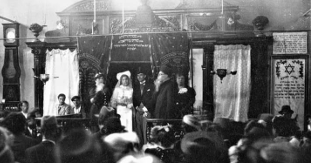
Renee and Edward’s wedding in Rhodes in August 1937.
Sara Surmany on the left.
Kasamiento – Marriage or La Boda – Wedding
On the island of Rhodes the town crier, kombidadoro, was entrusted with inviting the entire community in the Jewish quarter to the wedding and delivering gifts to the bride. A band of musicians, tanyidores, was sent by the groom to lead the bridal procession to the synagogue.
It was customary for the bride’s family to buy a new prayer shawl, talleth, for the groom for the wedding ceremony. Both sets of parents hold the prayer shawl over the bride and groom, echar talleth, who are blessed under a canopy, huppa, while they recite the seven blessings, signifying that the bride will now be under the groom’s care and protection. The couple would face the guests in the synagogue with their back to the Aron Kodesh
After the bride is presented with a plain gold wedding band by the groom, the couple sip the wine and are then given the sacred priestly blessing by a Cohen. The groom, with great exuberance, then stamps on a glass, representing the destruction of the Second Temple of Jerusalem destroyed in 69 CE, to recall that in times of joy we also remember times of sadness.
After the ceremony, marzipan and candied almonds, bon bons, are offered to the guests, who extend their profuse wishes, Mazal alto ke tengan los novios, Good luck to the newlyweds. Great jubilation and celebration follows with folk dancing, baylar chiftetelli. After enjoying a banquet of Sephardic delicacies, the guests wish the couple, Siempre fiestas i alegrias, May there always be celebrations and happy events, as they take their leave.
Rebecca Amato Levy’s reflections of weddings in Rhodes
The evening before the wedding was the last night the bride spent in her parent’s home. Her girl friends came to be with her. They painted her fingernails and toenails (in Rhodes, they used henna) and fixed and styled her hair.
The wedding day was usually Friday. Early Friday afternoon, about 1:00PM, the bride dressed, and – accompanied by her bridesmaids and guests – she began the procession to the Synagogue. The groom sent a band of musicians called tanyidores to lead the procession. The father of the bride led her through the streets and the relatives threw rice at her as she left her house. If the father of the bride was deceased, a brother or uncle replaced him. They would arrive at the Synagogue for the ceremony. The service was in two parts-the Kidushim and the Beraha. For the Kidushim, both the bride and groom’s family sent a young member of the family to sit on either side of the bride and groom. For the beraha they did the same thing with older members of the families. This was considered quite an honour. The rabbi or cantor would read the ketouba (marriage contract) and it was then signed by two witnesses, one of the bride’s choosing and one of the groom’s. At the end of the ceremony, the groom stepped on a glass, breaking it. This was a reminder of the destruction of the Temple in Jerusalem.
After the ceremony, the wedding party returned to the groom’s house with the musicians and close relatives and friends. They drank and danced and stayed for dinner, which consisted of fish with sauce (agristada) and chicken with vegetables and rice. This is where the expression originated of pishkado, gallina i aros (fish, chicken and rice). This was followed by raki and wine, fruit, sweets and coffee. The celebration was interrupted when the men went to synagogue for services. Sometimes the services were read at home.
Then began a seven day celebration called hupa. During this time, the bride and groom never left the house, and friends and relatives came over to eat and keep them company. On the Sabbath following the wedding, the groom went to the Synagogue and participated in a special custom called Avram Siv, where special verses were sung for him. During this time, the mother of the bride came over to visit her daughter. The mother went into the bridal bedroom and removed the stained bed linens to present them to the mother-in-law, to prove the virginity of the daughter. The mother-in-law, now satisfied and happy, would bring out a tray of sweets to pass around to confirm that they were now officially married.
Another interesting custom was that on the seventh day of the hupa, the groom would go to the market and buy a fish. When he came home, he would find the bride locked up in the bathroom, usually guarded by a member of the family. He then had to pay some money to that person to free her. When she left the bathroom, he would throw the fish at her feet … as a token of fertility.
By the early 30’s, the bridal procession was replaced by automobiles transporting the bride to the Synagogue, and the dinner receptions were held at hotels. Weddings began to be celebrated on Sundays, and the French custom of distributing bonbonieras was adopted. Bonbonieras, prepared by the wealthy, consisted of Jordan almonds placed in a small porcelain saucer and distributed; the less wealthy would merely wrap them in a square of tulle or cellophane. Originally, everyone was invited to weddings; but later, printed invitations were sent only to those officially invited.
At my wedding in 1938, I insisted upon respecting the old custom of a Friday wedding with the procession through the streets of the Jewish Quarter. Bonbonieras were distributed, and after the ceremony, my new husband and I left for our honeymoon to the mountains to a lovely resort hotel called Hotel Profit Eliea.
The evening before the wedding was the last night the bride spent in her parent’s home. Her girl friends came to be with her. They painted her fingernails and toenails (in Rhodes, they used henna) and fixed and styled her hair.
The wedding day was usually Friday. Early Friday afternoon, about 1:00PM, the bride dressed, and – accompanied by her bridesmaids and guests – she began the procession to the Synagogue. The groom sent a band of musicians called tanyidores to lead the procession. The father of the bride led her through the streets and the relatives threw rice at her as she left her house. If the father of the bride was deceased, a brother or uncle replaced him. They would arrive at the Synagogue for the ceremony. The service was in two parts-the Kidushim and the Beraha. For the Kidushim, both the bride and groom’s family sent a young member of the family to sit on either side of the bride and groom. For the beraha they did the same thing with older members of the families. This was considered quite an honour. The rabbi or cantor would read the ketouba (marriage contract) and it was then signed by two witnesses, one of the bride’s choosing and one of the groom’s. At the end of the ceremony, the groom stepped on a glass, breaking it. This was a reminder of the destruction of the Temple in Jerusalem.
After the ceremony, the wedding party returned to the groom’s house with the musicians and close relatives and friends. They drank and danced and stayed for dinner, which consisted of fish with sauce (agristada) and chicken with vegetables and rice. This is where the expression originated of pishkado, gallina i aros (fish, chicken and rice). This was followed by raki and wine, fruit, sweets and coffee. The celebration was interrupted when the men went to synagogue for services. Sometimes the services were read at home.
Then began a seven day celebration called hupa. During this time, the bride and groom never left the house, and friends and relatives came over to eat and keep them company. On the Sabbath following the wedding, the groom went to the Synagogue and participated in a special custom called Avram Siv, where special verses were sung for him. During this time, the mother of the bride came over to visit her daughter. The mother went into the bridal bedroom and removed the stained bed linens to present them to the mother-in-law, to prove the virginity of the daughter. The mother-in-law, now satisfied and happy, would bring out a tray of sweets to pass around to confirm that they were now officially married.
Another interesting custom was that on the seventh day of the hupa, the groom would go to the market and buy a fish. When he came home, he would find the bride locked up in the bathroom, usually guarded by a member of the family. He then had to pay some money to that person to free her. When she left the bathroom, he would throw the fish at her feet … as a token of fertility.
By the early 30’s, the bridal procession was replaced by automobiles transporting the bride to the Synagogue, and the dinner receptions were held at hotels. Weddings began to be celebrated on Sundays, and the French custom of distributing bonbonieras was adopted. Bonbonieras, prepared by the wealthy, consisted of Jordan almonds placed in a small porcelain saucer and distributed; the less wealthy would merely wrap them in a square of tulle or cellophane. Originally, everyone was invited to weddings; but later, printed invitations were sent only to those officially invited.
At my wedding in 1938, I insisted upon respecting the old custom of a Friday wedding with the procession through the streets of the Jewish Quarter. Bonbonieras were distributed, and after the ceremony, my new husband and I left for our honeymoon to the mountains to a lovely resort hotel called Hotel Profit Eliea.
Marc D Angel, The Jews of Rhodes – Marriage
The most auspicious day for a wedding among the Moslems of the Ottoman Empire was Friday. Not surprisingly, Friday was also the popular day for weddings among the Jews of Rhodes. On the Thursday night before the marriage, the fiancé sent his fiancée a plate of henna surrounded by lit candles. His parents and friends delivered this gift while singing traditional wedding songs. Upon receiving this gift, the fiancée distributed it among the family and friends who had gathered at her home. During the marriage ceremony the next day, the bride and groom were covered with a prayer shawl while the seven wedding benedictions were being recited (nisuin).
Wedding parties apparently became quite lavish during the latter 19th century among some Rhodian Jews. Rabbi Rahamim H. Y. Israel sharply criticized the wastefulness involved in such weddings. Isn’t it great foolishness to spend two and three thousand arayot for food and drink at a wedding? In the rabbi’s view such extravagance was sinful.
During the week following the wedding, the bride’s trousseau (ashugar) was displayed for guests. The trousseau often included linens which contained elaborate decorations sewn or crocheted by the bride or her mother. The trousseau would be a source of significant pride for the bride and her family. Guests who came to examine it sang songs and showered praises on the newly-married young woman and her parents.
On the Sabbath following the marriage, the groom took an extra Torah scroll from the ark prior to the reading of the portion of the week. After the regular Torah reading was completed, the groom brought his special Torah scroll to the reader’s desk. The hazzan then read from it the portion of Genesis 24:1-7, in which Abraham commanded his servant Eliezer to find a proper wife for Isaac. The hazzan read each verse in Hebrew and then another individual sang the traditional Aramaic translation. Each verse of the translation was sung to a different melody. This ceremony was known as the Avraham siv, derived from the first two words of the Aramaic translation of Genesis 24:1.14
Following synagogue services, members of the congregation escorted the newlyweds to their home where a light repast was served. Refreshments included sweets such as Jordan almonds, baklava, and candies made of almond paste.
The most auspicious day for a wedding among the Moslems of the Ottoman Empire was Friday. Not surprisingly, Friday was also the popular day for weddings among the Jews of Rhodes. On the Thursday night before the marriage, the fiancé sent his fiancée a plate of henna surrounded by lit candles. His parents and friends delivered this gift while singing traditional wedding songs. Upon receiving this gift, the fiancée distributed it among the family and friends who had gathered at her home. During the marriage ceremony the next day, the bride and groom were covered with a prayer shawl while the seven wedding benedictions were being recited (nisuin).
Wedding parties apparently became quite lavish during the latter 19th century among some Rhodian Jews. Rabbi Rahamim H. Y. Israel sharply criticized the wastefulness involved in such weddings. Isn’t it great foolishness to spend two and three thousand arayot for food and drink at a wedding? In the rabbi’s view such extravagance was sinful.
During the week following the wedding, the bride’s trousseau (ashugar) was displayed for guests. The trousseau often included linens which contained elaborate decorations sewn or crocheted by the bride or her mother. The trousseau would be a source of significant pride for the bride and her family. Guests who came to examine it sang songs and showered praises on the newly-married young woman and her parents.
On the Sabbath following the marriage, the groom took an extra Torah scroll from the ark prior to the reading of the portion of the week. After the regular Torah reading was completed, the groom brought his special Torah scroll to the reader’s desk. The hazzan then read from it the portion of Genesis 24:1-7, in which Abraham commanded his servant Eliezer to find a proper wife for Isaac. The hazzan read each verse in Hebrew and then another individual sang the traditional Aramaic translation. Each verse of the translation was sung to a different melody. This ceremony was known as the Avraham siv, derived from the first two words of the Aramaic translation of Genesis 24:1.14
Following synagogue services, members of the congregation escorted the newlyweds to their home where a light repast was served. Refreshments included sweets such as Jordan almonds, baklava, and candies made of almond paste.
Order of Ceremony
Before the wedding ceremony, the groom agrees to be bound by the terms of the ketubah (marriage contract) in the presence of two witnesses, whereupon the witnesses sign the ketubah. Usually these two witnesses are not closely related to the couple, but family and friends will be present for the signing. The ketubah details the obligations of the groom to the bride, among which are food, clothing, and marital relations. This document has the standing of a legally binding agreement, although it may be hard to collect these amounts in a secular court. It is often written as an illuminated manuscript that is framed and displayed in their home. Under the chuppah (wedding canopy – a tallit according to the Sephardi custom), it is traditional to read the signed ketubah aloud, usually in the Aramaic original, but sometimes in translation. Traditionally, this is done to separate the two basic parts of the wedding.
Two blessings are recited before the betrothal; a blessing over wine, and the betrothal blessing, which is specified in the Talmud. The wine is then tasted by the couple.
Rings are not actually required; they are simply the most common way (since the Middle Ages) of fulfilling the bride price requirement. The bride price (or ring) must have a monetary value no less than a single prutah (the smallest denomination of currency used during the Talmudic era). The low value is to ensure that there are no financial barriers to access marriage.
When the groom gives the bride a ring, traditionally a plain wedding band, he recites the declaration: Behold, you are consecrated to me with this ring according to the law of Moses and Israel. The groom places the ring on the bride’s right index finger. According to traditional Jewish law, two valid witnesses must see him place the ring.
Differences in marriage rituals between Sephardim & Ashkenazim
Traditionally, the Ashkenazi bride and groom fast on their wedding day. The Sephardic view is quite different. The wedding day is viewed as a celebration day or a personal/community holiday; therefore, fasting is not an option. They are expected to savour a meal honouring the occasion. Also, Sephardic Jews have no tradition of bedeken, or veiling of the bride.
As Sephardim do not fast, there is no tradition of yichud (separation), where the bride and groom retreat for a short time for some alone time and a bit of refreshment directly following the chuppah. Instead, the newly -married couple at a Sephardic wedding immediately joins their guests to commence with the festivities.
The tradition of a chuppah with four poles is not a Sephardic wedding tradition. Rather, the Sephardic bride and groom stand together, sheltered under the groom’s wedding tallit (prayer shawl) covering their heads. This symbolizes the home the two will build together, one that we hope will be imbued with holiness.
During the ceremony, the Sephardic bride does not circle her groom seven times, as is the Ashkenazic custom. The Sephardic couple generally faces the audience with a tallit draped over their heads, and the officiating rabbi has his back to the guests.
Historically, Sephardic weddings would take place during the day and not under the stars. Today, very often the Sephardic synagogue wedding ceremony takes place within the synagogues sanctuary.
In stark contrast to the Kittle the Sephardic groom wears a newly purchased Tallith. Usually a gift from the bride, and if the ceremony is during the day the groom recites the blessing Lehitatef Bezizit and Shehecheyanu (the blessing that offers thanks for having reached this moment). If the ceremony is in the evening only Shehecheyanu is recited. The assumption being that the Mitzvah of marriage and the joy associated with the moment warrants the recitation of Shehecheyanu.
With respect to the immersion in the mikve, the Sephardic bride will recite the blessings before immersion, while the Ashkenazi bride will immerse, recite and then immerse, recite, immerse, recite.
Essentially, traditional Sephardic and Ashkenazic ketubah texts are similar in the language (Aramaic), intent, function, and wording. There are a few differences, however. For example, the Sephardic bride, who has formerly been married, is not differentiated from first-time brides as the Ashkenazim will do by omitting the word mi’d’orata. Very often, the Sephardic ketubah will refer to the bride and groom by recording several generations past and not just their parents. Sometimes, a Sephardic text will elaborate on the bride or groom’s family, if it was particularly illustrious. There is no set sum of money in Sephardic ketubahs as in the Ashkenazi (set at 200 zuzim) This was to be negotiated between the families. And, as well, there are variations in spelling and wording.
Traditionally, the Ashkenazi bride and groom fast on their wedding day. The Sephardic view is quite different. The wedding day is viewed as a celebration day or a personal/community holiday; therefore, fasting is not an option. They are expected to savour a meal honouring the occasion. Also, Sephardic Jews have no tradition of bedeken, or veiling of the bride.
As Sephardim do not fast, there is no tradition of yichud (separation), where the bride and groom retreat for a short time for some alone time and a bit of refreshment directly following the chuppah. Instead, the newly -married couple at a Sephardic wedding immediately joins their guests to commence with the festivities.
The tradition of a chuppah with four poles is not a Sephardic wedding tradition. Rather, the Sephardic bride and groom stand together, sheltered under the groom’s wedding tallit (prayer shawl) covering their heads. This symbolizes the home the two will build together, one that we hope will be imbued with holiness.
During the ceremony, the Sephardic bride does not circle her groom seven times, as is the Ashkenazic custom. The Sephardic couple generally faces the audience with a tallit draped over their heads, and the officiating rabbi has his back to the guests.
Historically, Sephardic weddings would take place during the day and not under the stars. Today, very often the Sephardic synagogue wedding ceremony takes place within the synagogues sanctuary.
In stark contrast to the Kittle the Sephardic groom wears a newly purchased Tallith. Usually a gift from the bride, and if the ceremony is during the day the groom recites the blessing Lehitatef Bezizit and Shehecheyanu (the blessing that offers thanks for having reached this moment). If the ceremony is in the evening only Shehecheyanu is recited. The assumption being that the Mitzvah of marriage and the joy associated with the moment warrants the recitation of Shehecheyanu.
With respect to the immersion in the mikve, the Sephardic bride will recite the blessings before immersion, while the Ashkenazi bride will immerse, recite and then immerse, recite, immerse, recite.
Essentially, traditional Sephardic and Ashkenazic ketubah texts are similar in the language (Aramaic), intent, function, and wording. There are a few differences, however. For example, the Sephardic bride, who has formerly been married, is not differentiated from first-time brides as the Ashkenazim will do by omitting the word mi’d’orata. Very often, the Sephardic ketubah will refer to the bride and groom by recording several generations past and not just their parents. Sometimes, a Sephardic text will elaborate on the bride or groom’s family, if it was particularly illustrious. There is no set sum of money in Sephardic ketubahs as in the Ashkenazi (set at 200 zuzim) This was to be negotiated between the families. And, as well, there are variations in spelling and wording.
Blessings
Blessings recited before the betrothal:
Said by the Rabbi under the chuppah:
בָּרוּךְ אַתָּה יְיָ אֱלֹהֵֽינוּ מֶֽלֶךְ הָעוֹלָם בּוֹרֵא פְּרִי הַגָּֽפֶן׃
Baruch ata Adonai, Eloheinu melech ha’olam, borei p’ri hagafen.
Blessed are you, Lord our God, Ruler of the Universe, who creates the fruit of the vine.
ברוּךְ אתּה י-י א-להינו מלךְ העוֹלָם אשׁר קדשׁנוּ בּמצוֹתיו וצוָנוּ על העריות ואָסר לָנוּ את הארוּסוֹת והתּיר לָנוּ את הנשׂוּאוֹת לָנוּ על ידי חפּה וקדוּשׁין. בּרוּךְ אַתּה י-י מקדשׁ עמוֹ ישראל על ידי חפּה וקדוּשׁין
Praised be Thou, O L-rd our G‑d, King of the universe who has sanctified us with His commandments and has commanded us concerning illicit relations; and has prohibited us those who are merely betrothed; but has permitted to us those lawfully married to us by chuppah and kiddushin. Blessed art thou G‑d, who has sanctified His people Israel by chuppah and kiddushin.
The groom’s blessing as he gives his kallah (bride) the ring is:
הרי את מקודשת לי בטבעת זו כדת משה וישרא
Harei et mekudeshet li betaba’at zo k’dat Moshe v’Israel
Behold, you are consecrated to me with this ring according to the law of Moses and Israel.
Sheva Brachot
The Sheva Brachot (seven blessings) are recited under the chuppah (wedding canopy) and then also at the meal following the wedding as well as in the week after the wedding, the Sheva Brachot (seven blessings) are the heart of the Jewish wedding ceremony.
בָּרוּךְ אַתָּה יְיָ אֱלֹהֵֽינוּ מֶֽלֶךְ הָעוֹלָם בּוֹרֵא פְּרִי הַגָּֽפֶן׃
Baruch ata Adonai, Eloheinu melech ha’olam, borei p’ri hagafen.
Blessed are you, Lord our God, Ruler of the Universe, who creates the fruit of the vine.
בָּרוּךְ אַתָּה יְיָ אֱלֹהֵֽינוּ מֶֽלֶךְ הָעוֹלָם שֶׁהַכֹּל בָּרָא לִכְבוֹדוֹ
Baruch ata Adonai, Eloheinu melech ha’olam, she’hakol bara likhvodo.
Blessed are you, Lord our God, Ruler of the Universe, who created everything for His glory.
ג בָּרוּךְ אַתָּה יְיָ אֱלֹהֵֽינוּ מֶֽלֶךְ הָעוֹלָם יוֹצֵר הָאָדָם׃
Baruch ata Adonai, Eloheinu melech ha’olam, yotzer ha’adam.
Blessed are you, Lord our God, Ruler of the Universe, who created humanity.
ד בָּרוּךְ אַתָּה יְיָ אֱלֹהֵֽינוּ מֶֽלֶךְ הָעוֹלָם אֲשֶׁר יָצַר אֶת הָאָדָם בְּצַלְמוֹ בְּצֶֽלֶם דְּמוּת תַּבְנִיתוֹ וְהִתְקִין לוֹ מִמֶּֽנּוּ בִּנְיַן עֲדֵי עַד. בָּרוּךְ אַתָּה יְיָ יוֹצֵר הָאָדָם
Baruch ata Adonai, Eloheinu melech ha’olam, asher yatzar et ha’adam b’tzalmo b’tzelem d’mut tavnito v’hitkin lo mimenu binyan adei ad. Baruch ata Adonai, yotzer ha’adam.
Blessed are you, Lord our God, Ruler of the Universe, who created humanity in His image, in the image of the likeness of his form, and made for them an everlasting establishment. Blessed are you, Lord, who created humanity.
שׂוֹשׂ תָּשִׂישׂ וְתָגֵל הָעֲקָרָה בְּקִבּוּץ בָּנֶֽיהָ לְתוֹכָהּ בְּשִׂמְחָה. בָּרוּךְ אַתָּה יְיָ מְשַׂמֵּֽחַ צִיּוֹן בְּבָנֶֽיהָ
Sos tasis v’tagel ha’akara b’kibbutz baneha l’tocah b’simcha. Baruch ata Adonai, m’sameiach tzion b’vaneha.
May the barren one (Jerusalem) rejoice greatly and delight in the ingathering of her children within her in joy. Blessed are you Lord who causes Zion to rejoice with her children.
שַׂמֵּֽחַ תְּשַׂמַּח רֵעִים הָאֲהוּבִים כְּשַׂמֵּחֲךָ יְצִירְך בְּגַן עֵֽדֶן מִקֶּֽדֶם. בָּרוּךְ אַתָּה יְיָ מְשַׂמֵּֽחַ חָתָן וְכַלָּה׃
Sameach t’samach rei’im ha’ahuvim k’simchacha ytzircha b’gan eden mikedem. Baruch ata Adonai, m’sameach chatan v’kala.
The loving partners shall rejoice as You caused your creatures to delight in the Garden of Eden of old. Blessed are you Lord who causes the groom and bride to rejoice.
ז בָּרוּךְ אַתָּה יְיָ אֱלֹהֵֽינוּ מֶֽלֶךְ הָעוֹלָם אֲשֶׁר בָּרָא שָׂשׂוֹן וְשִׂמְחָה חָתָן וְכַלָּה. גִּילָה רִנָּה דִּיצָה וְחֶדְוָה אַהֲבָה וְאַחֲוָה וְשָׁלוֹם וְרֵעוּת. מְהֵרָה יְיָ אֱלֹהֵֽינוּ יִשָּׁמַע בְּעָרֵי יְהוּדָה וּבְחֻצוֹת יְרוּשָׁלָםִ, קוֹל שָׂשׂוֹן וְקוֹל שִׂמְחָה קוֹל חָתָן וְקוֹל כַּלָּה קוֹל מִצְהֲלוֹת חֲתָנִים מֵחֻפָּתָם וּנְעָרִים מִמִּשְׁתֵּה נְגִינָתָם. בָּרוּךְ אַתָּה יְיָ מְשַׂמֵּֽחַ חָתָן עִם הַכַּלָּה׃
Baruch ata Adonai, Eloheinu melech ha’olam, asher bara sason v’simcha chatan v’chala. Gila, rina, ditzah v’chedva, ahava v’achava v’shalom v’rei’ut. M’heira Adonai Eloheinu yishama b’arei yehuda u’vchutzot yerushalayim, kol sason v’kol simcha kol chatan v’kol kala, kol mitzhalot chatanim meichupatam u’n’arim mimishtei n’ginatam. Baruch ata Adonai m’sameiach chatan im ha’kala.
Blessed are you, Lord our God, Ruler of the Universe, who creates happiness and joy, groom and bride. Exultation, delight, amusement, and pleasure, love and brotherhood, peace and friendship. Soon, Lord our God, may the sound of happiness and the sound of joy and the voice of the groom and the voice of the bride be heard in the cities of Judah and the streets of Jerusalem — the rejoicing of groom from their huppahs and youths from their singing banquets. Blessed are you Lord who makes the groom rejoice with the bride.
Under the Chuppah
During the ceremony, the seven blessings are traditionally chanted in Hebrew and may also be read in English. In the Sephardic tradition, a parent often wraps the bride and groom in a tallit (prayer shawl) before the recitation of the blessings, to recognize the intimacy and significance of the moment.
It is customary for the Sheva Brachot to be recited again during the wedding celebration over a glass of wine, following the Birkat Hamazon (grace after meals). In this case, the first blessing (Kiddush) is moved to the final position. This second sharing of the blessings gives couples an additional opportunity to honour their loved ones by inviting them to offer one of the blessings.
At the Wedding Reception
The Week After the Wedding
For the seven days following the wedding, the bride and groom are treated like a queen and king, and are invited to dine at the home of a different friend or relative on each night. These festive meals were also called “Sheva Brachot.” Following dinner, the seven blessings would be recited again — as long as a minyan of 10 were present and there was at least one new person who hadn’t been at the wedding present. The idea of the dinners was to have real community celebrations for the couple, and parties often went into the night. During generations when marriages were arranged and couples may have met just before marriage the Sheva Brachot meals served as a way for the couple to get to know each other, while being supported by the community.
MENU
The wedding feast
Family and friends were involved in the extraordinary preparation for the wedding feast. The food included a splendid array of handcrafted marzipan and sweet treats to augur a long, healthy new life for the couple. Other sweet pastries with nuts and seeds were served as a symbol of fertility.
A wonderful article by Marcia Weingarten on the preparation of sweet treats before the wedding as well as an explanation of masapan (marzipan) a sweet made for most celebrations as well as a recipe, can be found here.

Specific Conventions Relating to This Event
Honours to be given:
- The two witnesses who are signing the ketubah – these are not family members but friends
- It is considered an honour to be called up to read one of the sheva brachot (seven blessings) under the chuppah.
Restrictions
Weddings are not permitted to take place during the month of Marheshvan, the month in which the biblical flood took place. Weddings can take place after the thirty-third day of the counting of the Omer, which is the forty-nine days between Passover and Shavuot. The rest of the year is considered an auspicious time for a wedding.
After the Wedding
Shabbat de Avraham Siv – Sabbath after the wedding:
On the Shabbat after the wedding the bride and groom attend synagogue and the husband is given the honour of reading a portion of the Torah – Genesis 24.1 – recounting the Story of Abraham selecting a wife for his son Isaac. For this ceremony, an extra Sefer Torah is taken out. It is not read until we are finished with the Aftarah. At that point, we place the special Sefer Torah on the Tevah and call up the bridegroom, the Hatan, who will say the blessings of the Torah as usual. From the Sefer Torah, the reader sings the first seven verses of Genesis, Chapter 24 (פ’ חיי שרה) alternating each sentence with its Aramaic translation, which is sung by someone else. Each Aramaic verse, however, is sung to the tune of a different Makam (musical mode or theme).
The appropriateness of the seven sentences can be found in the fact that Abraham, who is old and nearing death, makes his servant Eliezer swear that he will go back to Abraham’s birthplace and choose a wife for his son Isaac… Eliezer came back with Rebecca, a beautiful match and soulmate for Isaac. The congregation’s wishes, likewise, go out to the married couple for a very happy marriage.” – Hazzan Isaac Azose.
Menu:
Later, a lavish tea with a table laden with sweets, mesa alegre, Jordan almonds, baklava, and candies made of almond paste awaited the congregation.
Additional Resources
Comparative Study of the Sephardic and Ashkenazic Wedding Ceremony
The Institute for Jewish Ideas
The Seven Blessings (Sheva Brachot) for a Jewish Wedding
My Jewish Learning
Comparative Study of the Sephardic and Ashkenazic Wedding Ceremony
The Institute for Jewish Ideas
The Seven Blessings (Sheva Brachot) for a Jewish Wedding
My Jewish Learning
Sources and References
- Rebecca Amato Levy, I Remember Rhodes (1987).
- Stella Cohen, Stella’s Sephardic Table (2012).
- “Jewish Views on Marriage”. Wikipedia. Available at: https://en.wikipedia.org/wiki/Jewish_views_on_marriage.