
In 1896, less than a year after the arrival of the Pioneer Column[1], the brothers Solomon and Moussa Benatar arrived in what was then simply known as Mashonaland. They are the first recorded Sephardim to arrive in Zimbabwe but in their wake came many others; young men mainly from impoverished backgrounds, knowing little or no English but men who were searching for a better life
[1] The Pioneer Column was a force raised by Cecil Rhodes and his British South Africa Company in 1890 and used in his efforts to annex the territory of Mashonaland, later part of Zimbabwe (once Southern Rhodesia).
The Sephardim of Zimbabwe
There is an excellent and comprehensive website on the over 150 years presence of the Jewish community in Zimbabwe and Zambia. You can find it here.
This section is taken largely from the publication, Zimbabwe Sephardi Hebrew Congregation 50 Golden Years 1931-1981
Contents
1905
From 1905 onwards the flow of immigrants from Rhodes Island increased. With a limited knowledge of English, the early Sephardim were forced to settle in the bush areas, normally as small traders carrying on business near mines or in farming areas. But their humble beginnings bore promise for the future. First, they were determined to establish themselves and to make good. Second, the local European population – mainly Anglo-Saxon — encouraged the setting up of trading stores while they engaged largely in farming and mining. And third, the African population, exposed to European ways, began to buy readily from the stores.
But naturally in the course of time these scattered “outposts” became unsatisfactory.
The desire grew among the Sephardim to be close together as they had been on Rhodes Island. As wives were brought out to the new colony, the need to educate children became urgent. Gradually, therefore, the Sephardim began to leave their isolated trading stores and move into the towns. Most of the Sephardim settled in Salisbury.
1931
When they arrived, they found thạt the Ashkenazim had established a flourishing community. Originally they became members of the Salisbury Hebrew Congregation but this was not an entirely harmonious union. The Sephardim were very much a minority group. Their cultural background was different. Their traditions were different, they even spoke a different language. In 1931 the Sephardim in the community felt strong enough to break away and to form their own congregation. On completion of the High Holy Day Festivals the Sephardim officially formed the Hebrew Sephardic Society of Rhodesia.
1934 – 1940
In the early years the young society had no permanent home and services were held in various venues, as divergent as hired halls and private homes. On the 9th September, 1934 at the fourth annual general meeting of the congregation, it was decided to purchase a stand in what was then known as Jameson Avenue. In 1940 an adjacént stand was purchased at the instigation of I. R. Rosin and shortly thereafter the Sephardi Hall was built. It was the first true home of the Sephardi community in the country and served as a place of worship, a school and a communal centre.
1944
In 1944 Mr. I. R. Rosin approached the Chief Rabbi of Cape Town, Dr. Abrahams, regarding the employment of a minister for the congregation. Dr. Abrahams recommended Rabbi Dr. M. Papo who at that time was serving in Manchester. Dr. Papo was persuaded to come to Africa and arrived in 1944. Rabbi Papo was the Rabbi of the community for just under 20 years.
After the war, Sephardim and Ashkenazim Holocaust survivors arrived in Rhodesia. The Sephardi Congregation sent a representative to investigate conditions in Rhodes and to provide funds and practical assistance to try and restore a Jewish presence on the island. It also organised for a Greek-Israeli Commission to arrange compensation for Jewish losses
1953
In January 1953 the S. N. Alhadeff Nursery School was opened under the supervision of the late Mrs. Clara Mogilnic, a qualified nursery school teacher. The first three children — in fact they were the sum total of the pupils — were Bella King, Marc Naim and Victor Hasson. By the second term the numbers however had risen to twenty-five children. In 1981, the nursery school had more than sixty pupils and a reputation (among Jew and gentile alike) as one of the best nursery schools in the country.
In 1953 the Sephardi community founded their own Ladies Guild.
Film showing the opening of the Gatooma Shul
Kadoma (Gatooma) Jewish Community – Part 6 film showing the opening of the Gatooma Shul on 16th August 1953. Shows Rabbis M Konviser, Papo and Reverand Yesorsky plus heads of the local community Jacob Hasson, R Sternberg, J Burke and heads of the Salisbury Communities, Lionel Harris, Dr I R Rosin and others including Cecil Jacobs.
https://www.youtube.com/watch?v=at8kTtQK5b8
1958
But just as the institutes of learning under the wing of the Sephardi community had to grow, so did the community itself. It became apparent that the hall on Jameson Avenue would not suffice. In 1951 Mr. I. R. Rosin was instrumental in purchasing a new site for the Rhodes Community Memorial Hall named in memory of the annihilation of the Rhodes community. It served initially the dual purpose of the Sha’are Shalom synagogue (which was consecrated on 1 June 1958) and community centre. It was also there that the first and only Sephardi school in Africa was opened in 1962; it was called the “Samuel Leon Sephardi Hebrew School”.
Sha’are Shalom (Sephardi) Congregation
FOUNDED IN 1931
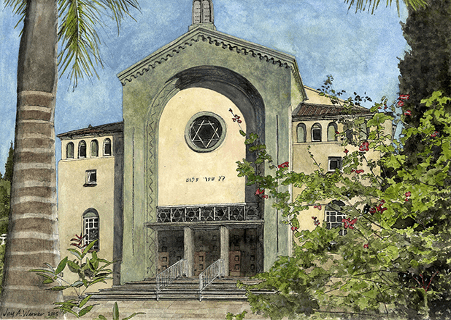
SHA’ARE SHALOM CONGREGATION SYNAGOGUE (COMPLETED IN 1958)
54 Josiah Chinamano Avenue, Harare (formerly Salisbury), Zimbabwe (formerly Rhodesia and Southern Rhodesia)
Exterior View (2005), 15” x 11”, Watercolour, Jay A. Waronker
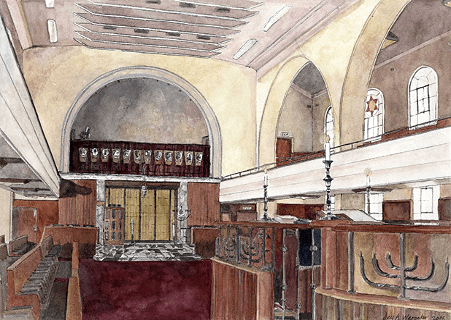
SHA’ARE SHALOM CONGREGATION SYNAGOGUE (COMPLETED IN 1958)
54 Josiah Chinamano Avenue
Harare (formerly Salisbury), Zimbabwe (formerly Rhodesia and Southern Rhodesia)
Interior View (2005), 15” x 11” Watercolor, Jay A. Waronker
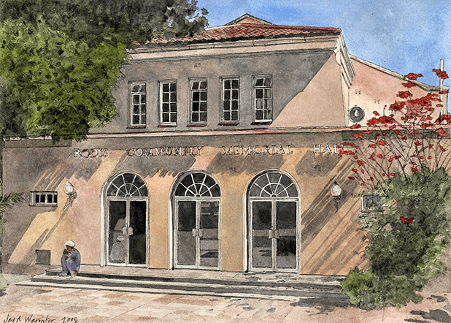
SHA’ARE SHALOM CONGREGATION RODIS MEMORIAL HALL (COMPLETED IN 1957)
54 Josiah Chinamano Avenue
Harare (formerly Salisbury), Zimbabwe (formerly Rhodesia and Southern Rhodesia)
Exterior View (2005), 15” x 11” Watercolor, Jay A. Waronker
1960 – 1970
In January 1960, Rev. S. R. Ichay was appointed associate minister of the congregation. In 1963, upon the retirement of Dr. Papo to Vienna, Rev. Ichay took over as minister. He held the appointment for five years until he moved to Atlanta, Georgia. In 1967 Reverend I. Benzaquen joined as assistant minister. In 1976 he emigrated to Brazil and was succeeded by the Rev. R. Suiza who served as minister until 1979 when he emigrated to South Africa where he became the rabbi of the Sephardi community in Cape Town. From the time of its official establishment, the Sephardi Congregation adopted the ‘de Sola Pinta‘ prayerbook and retained the tunes and melodies from the island of Rhodes. Hebrew was maintained for the services and English which was becoming the spoken language, in addition to Ladino, was used for the sermons.
Rhodesian Jewry considered itself as a part of Klal Israel and always supported other Jewish communities. WIZO was the first Zionist organisation to attract Sephardi participation and it had two Sephardi women on its first committee.
During the Congo crisis in 1960, the Rhodesian Board of Deputies did its utmost to help Jewish refugees. Sephardim welcomed their brothers and sisters with incredible warmth and hospitality.
It was perhaps this co-operation between Ashkenazim and Sephardim which helped to reduce the rift between these two groups.
Opening of Samuel Leon Sephardi Hebrew School
In May 1962 this Sephardi Hebrew School was opened. The original 8 mm film was digitized by Isaac Menashe. The editing of the film was done by Dave Bloom and Isaac Menashe.
https://www.youtube.com/watch?v=RuST8l1-ROk
1970
By 1970, the two Orthodox synagogues shared a spiritual leader and amalgamated their nursery schools. By then, the total Jewish population of Rhodesia was 5 500; half lived in Salisbury of whom a third were Sephardim and the other half lived in Bulawayo with only a handful of Sephardim.
1979
In 1965, the white minority government of Southern Rhodesia, under Prime Minister Ian Smith, unilaterally declared independence as Rhodesia, in response to British demands that the colony be handed over to black majority rule. Rhodesia was then subject to international sanctions, and black nationalist organizations began an insurgency, known as the Rhodesian Bush War, which lasted until 1979, when the Rhodesian government agreed to settle with the black nationalists. By the time the Rhodesian Bush War ended in 1979, most of the country’s Jewish population had emigrated, along with many other whites.
1980 – 1990
Some Jews however chose to stay when the country was transferred to black majority rule and renamed Zimbabwe in 1980. However, emigration continued, and by 1987, only 1,200 Jews out of an original population of some 7,000 remained. Most Rhodesian Jews emigrated to Israel or South Africa, seeking better economic conditions and Jewish marriage prospects.
1990 – Today
Until the late 1990s, rabbis resided in Harare and Bulawayo, but left as the economy and community began to decline. Today there is no resident Rabbi.
In Harare today because of small numbers of congregants the prayers alternate between the Ashkenazi and Sephardi synagogues.
Additional Resources
Rhodesian Jewry and its Story
Eric Rosenthal,
A History of the Jewish Community of Zimbabwe
B A Kosmin, 1980, Majuta
Rhodesian Jews – A Brief History
Manfred Schwartz
60th anniversary, 1931-1991, of the Sephardi Hebrew Congregation of Zimbabwe
George A. Smathers Library Homepage
Zimbabwe Sephardi Hebrew Congregation 50 Golden Years 1931-1981
Zimbabwe Jewish Community
The 75th Anniversary of the Harare Sephardi Hebrew Congregation
Published in early 2007
Opening of Samuel Leon Sephardi Hebrew School
YouTube Channel: Dave Bloom
Kadoma (Gatooma) Jewish Community – Part 6
Film showing the opening of the Gatooma Shul on 16th August 1953. Shows Rabbis M Konviser, Papo and Reverand Yesorsky plus heads of the local community Jacob Hasson, R Sternberg, J Burke and heads of the Salisbury Communities, Lionel Harris, Dr I R Rosin and others including Cecil Jacobs.
The forgotten story of Zambia’s Jewish settlers
Mark Tutton, CNN
From Rhodes to Cape Town: South Africa’s Sephardi Jews and their Heritage
Mathy Joffe, 1992
Jews from Rhodes in Central and Southern Africa
Hirschon, R. (2005).In: Ember, M., Ember, C.R., Skoggard, I. (eds) Encyclopedia of Diasporas. Springer, Boston, MA.
Rhodesian Jewry and its Story
Eric Rosenthal,
A History of the Jewish Community of Zimbabwe
B A Kosmin, 1980, Majuta
Rhodesian Jews – A Brief History
Manfred Schwartz
60th anniversary, 1931-1991, of the Sephardi Hebrew Congregation of Zimbabwe
George A. Smathers Library Homepage
Zimbabwe Sephardi Hebrew Congregation 50 Golden Years 1931-1981
Zimbabwe Jewish Community
The 75th Anniversary of the Harare Sephardi Hebrew Congregation
Published in early 2007
Opening of Samuel Leon Sephardi Hebrew School
YouTube Channel: Dave Bloom
Kadoma (Gatooma) Jewish Community – Part 6
Film showing the opening of the Gatooma Shul on 16th August 1953. Shows Rabbis M Konviser, Papo and Reverand Yesorsky plus heads of the local community Jacob Hasson, R Sternberg, J Burke and heads of the Salisbury Communities, Lionel Harris, Dr I R Rosin and others including Cecil Jacobs.
The forgotten story of Zambia’s Jewish settlers
Mark Tutton, CNN
From Rhodes to Cape Town: South Africa’s Sephardi Jews and their Heritage
Mathy Joffe, 1992
Jews from Rhodes in Central and Southern Africa
Hirschon, R. (2005).In: Ember, M., Ember, C.R., Skoggard, I. (eds) Encyclopedia of Diasporas. Springer, Boston, MA.