
Purim, also known as ‘The Festival of Lots’, (because pur means lots in Hebrew and lots were cast in order to choose the date for the destruction of the Jewish people in the Persian empire) commemorates the saving of the Jewish people from annihilation at the hands of an official of the Achaemenid Empire named Haman, as it is recounted in the Book of Esther (usually dated to the 5th century BCE). His plans were foiled by Mordecai of the tribe of Benjamin, and Esther, Mordecai’s cousin and adopted daughter who had become queen of Persia after her marriage to the King Ahasuerus. The day of deliverance became a day of feasting and rejoicing among Jews.
Meaning and Significance
Contents
“Megila”
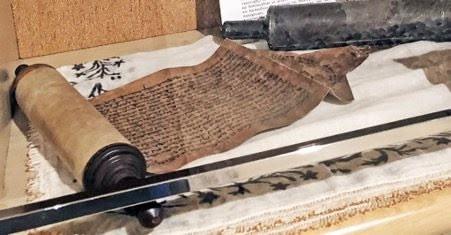
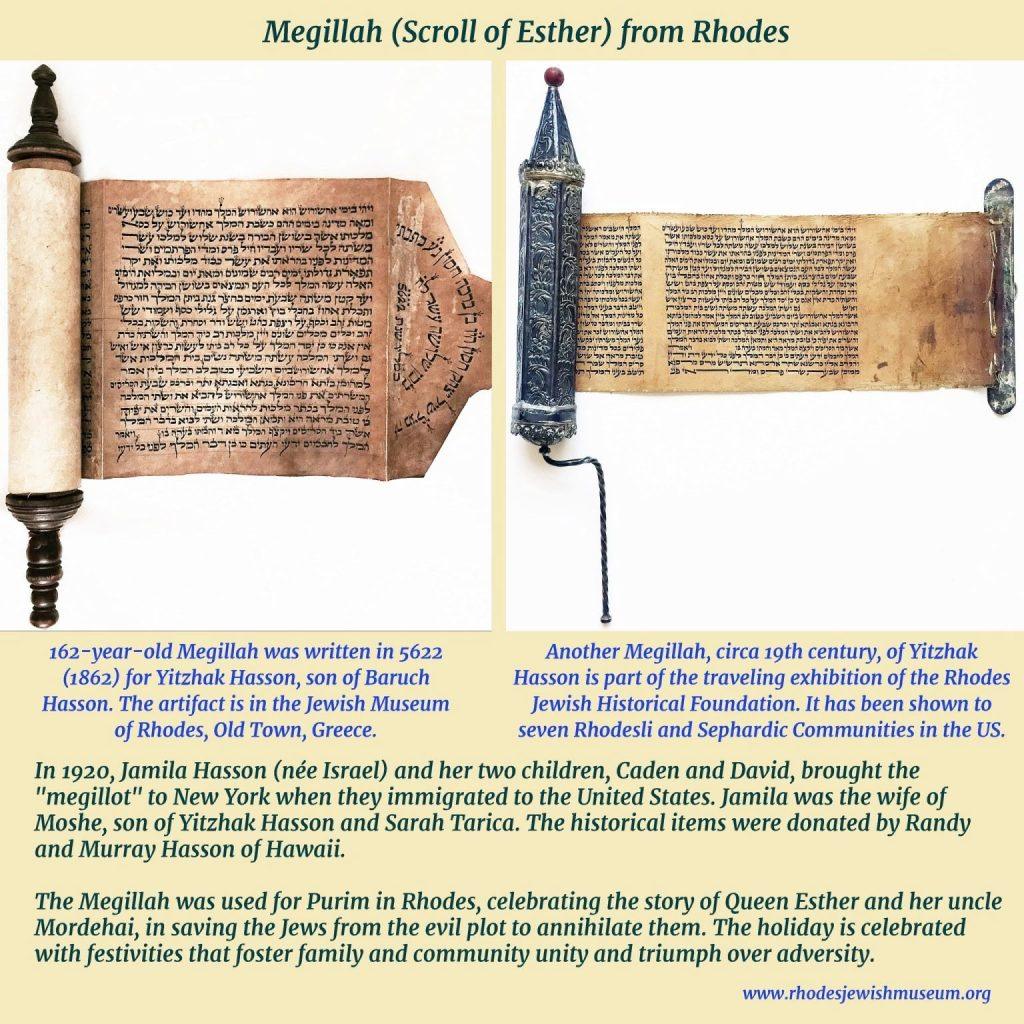
This “megila” used for Purim was handmade in Rhodes on parchment. The opening title page indicates that it was written in 5622 (=1862) for Yitzhak Hasson, the son of Baruch Hasson. From the family of Murray Hasson of Hawaii.
The Purim of Rhodes
In 1840 the Jewish community on the island of Rhodes faced the terrible accusation of having killed a gentile child to use his blood in baking matza. The Greeks were in competition with Jews in the sponge trade on the island of Rhodes which could have been the motivation for this blood libel.
The governor of the island arrested the leaders of the community and tortured them as they awaited execution. But the child was found alive and well on the island of Syra. The accusation proved baseless and the hapless captives released.
On the 14th of Adar, the Turkish sultan, Abed Almagid, issued a royal decree to be kept in the possession of the Jewish community, stating that the charge was false. From that day on, the Jews of Rhodes celebrated a double Purim in commemoration of that event. Special prayers and piyutim were recited in honour of Purim Rhodes, in addition to the usual Purim observances.
How Purim was Practised in Rhodes
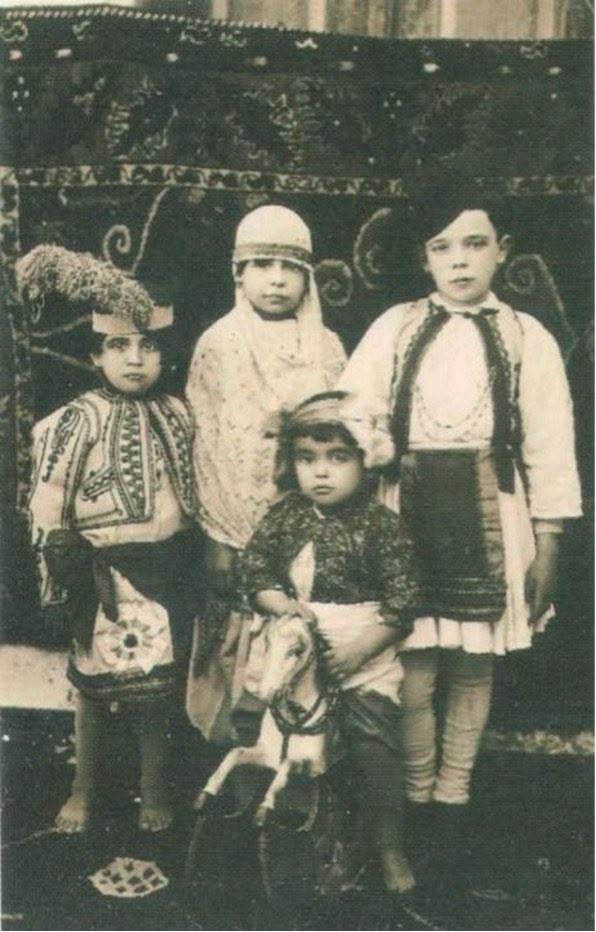
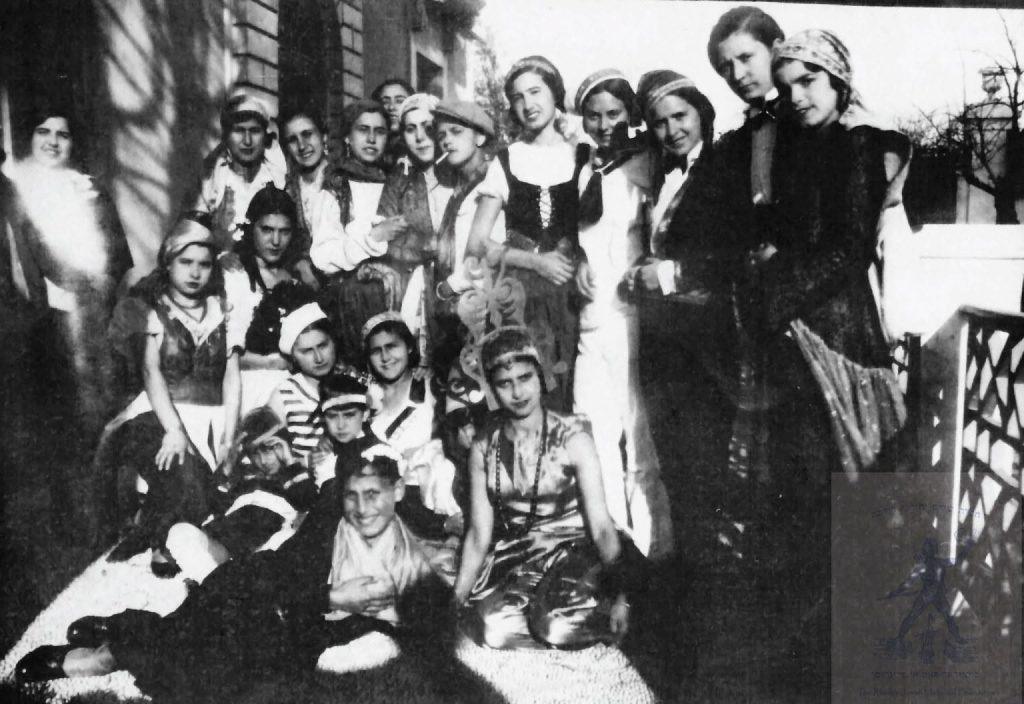
The streets of the juderia were alive with celebrations on Purim day. Jews closed their places of business. They dressed in costumes and played games in the roads. Families sent gifts of foodstuffs (platicos) to relatives and friends as well as to those in need. These packages, usually containing sweets and baked goods, were delivered by the children. As a reward for their services, the children received gifts of money from the recipients of the platicos. Sometimes, Jews took a horse-and-buggy ride to the lemon gardens outside Rhodes and bought fresh lemons.
A Traditional Greeting was Exchanged:
“Bwén Purim bienos áños
Byén ke tengámos
Tódos los áños.”
“Happy Purim, good years
May we have joy
All the years.”
Rebecca Amato Levy’s recollections of La Fiesta de Purim
The festival of Purim was celebrated with much enthusiasm and festivity on Rhodes. The first reason was to celebrate the victory of the Jews, led by Mordecai and Esther, over Haman. The second reason was that God saved the Jews of Rhodes during the incident of the “little Greek.”
This incident took place in 1840 on Rhodes during a period of much anti-Semitism and fanaticism. The Greeks at the time of Pesah accused the Jews of Rhodes of kidnapping and killing a boy and using his blood to make matsot.
This scandal was so evil that even the leaders of the community, including the Chief Rabbi were imprisoned. The Jewish community, however, tried every means to have the prisoners released. They contacted the powerful Jewish community of London and Paris. A committee was formed, led by the famous English philanthropist, Moses Montefiore. This committee set sail for Istanbul and succeeded in obtaining an audience with the Turkish Sultan where they pleaded clemency for the Jews who were unjustly imprisoned.
They demonstrated to the Sultan that according to Jewish law, we are forbidden to eat human blood. The Sultan realised that the Jews could not have killed the Greek boy and that the imprisoned were falsely accused. He ordered that messengers be sent to Rhodes to release the prisoners.
From this time onward the Jews of Rhodes celebrated Purim with an especially grand celebration. There was a continual fair for two days and two nights in the Wide Street, La Kay Ancha.
In my time I remember the food vendors, with their booths of shish kebab, bourekas, olives, cheese, sweets, fruits, lemonade, syrup drinks and snow cones.
Games of fortune were played, their tables filled with prizes of sweets and money, their owners barking out, “Look, here you can win, there you will lose. Win a section of sweets, a diamond-shaped piece of sweet.” “Mira ke es ganar por aki, mira ke es perder por aiya, un kashon, una kupeta.”
A line of horse and buggies, decorated with flowers and adornments would take us for a ride to the Puerta de la Mar (one of the seven gates leading to the ocean.) The drivers would cry out, “Ir i venir un grosh,” (to go and return for one grosh). Other buggies went as far as Zimbouli in the Greek quarter to drink their famous water. Others went to the Garden of Lemons “Guerta de los Limones” in the Turkish quarter to buy lemons. These two parks were open solely for the Jews on their religious holidays.
The children, dressed in their costumes and masks, collected money (“paras“) from their parents, relatives and neighbours and ran to the Wide Street to spend it.
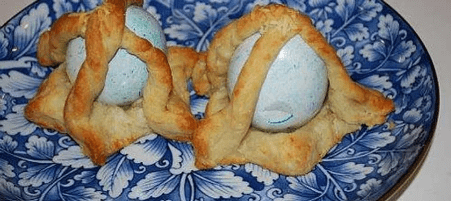
The custom on Rhodes for Purim was to serve desayuno de keso, (a fila dough filled with cheese) and hardboiled eggs. For the children, the hardboiled egg was covered with strips of dough, symbolising the hanging of Haman and was called a “fullar.”
As in other Sephardic communities, some Rhodeslis exchanged plates of sweets.
We, however, reserved these plates of “sweets” for Tu bi’Shevat. It is interesting to note that although we did not send plates of sweets for Purim, we still used the proverb, “Despues de Purim platikos.” Which means “after Purim, little plates.” This proverb is used in conjunction with a sentence, and implies “after the fact.” It was the custom on the first day of Purim to eat an additional important meal called “Seuda de Purim.” It commenced at lunchtime and sometimes lasted until dinner. It consisted of various types of foods, but it had to include charcoal-broiled meat and wine. They would eat and sing and drink. One of the favourite Purim songs was “Kuando Haman se Emboracho,” meaning “When Haman got drunk.”
The festival of Purim was celebrated with much enthusiasm and festivity on Rhodes. The first reason was to celebrate the victory of the Jews, led by Mordecai and Esther, over Haman. The second reason was that God saved the Jews of Rhodes during the incident of the “little Greek.”
This incident took place in 1840 on Rhodes during a period of much anti-Semitism and fanaticism. The Greeks at the time of Pesah accused the Jews of Rhodes of kidnapping and killing a boy and using his blood to make matsot.
This scandal was so evil that even the leaders of the community, including the Chief Rabbi were imprisoned. The Jewish community, however, tried every means to have the prisoners released. They contacted the powerful Jewish community of London and Paris. A committee was formed, led by the famous English philanthropist, Moses Montefiore. This committee set sail for Istanbul and succeeded in obtaining an audience with the Turkish Sultan where they pleaded clemency for the Jews who were unjustly imprisoned.
They demonstrated to the Sultan that according to Jewish law, we are forbidden to eat human blood. The Sultan realised that the Jews could not have killed the Greek boy and that the imprisoned were falsely accused. He ordered that messengers be sent to Rhodes to release the prisoners.
From this time onward the Jews of Rhodes celebrated Purim with an especially grand celebration. There was a continual fair for two days and two nights in the Wide Street, La Kay Ancha.
In my time I remember the food vendors, with their booths of shish kebab, bourekas, olives, cheese, sweets, fruits, lemonade, syrup drinks and snow cones.
Games of fortune were played, their tables filled with prizes of sweets and money, their owners barking out, “Look, here you can win, there you will lose. Win a section of sweets, a diamond-shaped piece of sweet.” “Mira ke es ganar por aki, mira ke es perder por aiya, un kashon, una kupeta.”
A line of horse and buggies, decorated with flowers and adornments would take us for a ride to the Puerta de la Mar (one of the seven gates leading to the ocean.) The drivers would cry out, “Ir i venir un grosh,” (to go and return for one grosh). Other buggies went as far as Zimbouli in the Greek quarter to drink their famous water. Others went to the Garden of Lemons “Guerta de los Limones” in the Turkish quarter to buy lemons. These two parks were open solely for the Jews on their religious holidays.
The children, dressed in their costumes and masks, collected money (“paras“) from their parents, relatives and neighbours and ran to the Wide Street to spend it.
The custom on Rhodes for Purim was to serve desayuno de keso, (a fila dough filled with cheese) and hardboiled eggs. For the children, the hardboiled egg was covered with strips of dough, symbolising the hanging of Haman and was called a “fullar.”
As in other Sephardic communities, some Rhodeslis exchanged plates of sweets.
We, however, reserved these plates of “sweets” for Tu bi’Shevat. It is interesting to note that although we did not send plates of sweets for Purim, we still used the proverb, “Despues de Purim platikos.” Which means “after Purim, little plates.” This proverb is used in conjunction with a sentence, and implies “after the fact.” It was the custom on the first day of Purim to eat an additional important meal called “Seuda de Purim.” It commenced at lunchtime and sometimes lasted until dinner. It consisted of various types of foods, but it had to include charcoal-broiled meat and wine. They would eat and sing and drink. One of the favourite Purim songs was “Kuando Haman se Emboracho,” meaning “When Haman got drunk.”
Purim in the Synagogue
On the Sabbath before Purim, Shabbat Zakhor, congregants made lots of noise in the synagogue when the section of the Torah was read dealing with Amalek (the enemy of the Israelites).
On the evening and day of Purim, the Book of Esther (Megillat Esther) was chanted for the community in the synagogue. There was also great noise when the Megillah was read on Purim day. This custom reflected the symbolic destruction of Amalek and enemies of the Jews in general. Adults clapped their hands and stamped their feet while children made noise with little hammers and noise-makers.
The Mitzvot of Purim
The four main Mitzvot (commandments) of Purim are:
- Listening to the reading of the megillah (the book of Esther) on the night and day of Purim;
- Eating a festive meal including drinking wine;
- Sending two kinds of food to a friend or family member as a gift; and
- Giving at least two gifts to two different poor people in food or in an amount of money that would be enough to purchase food.
A strong custom is making rowdy noise during the reading of the megillah to blot out the name of Haman (traditionally pronounced Aman among the Sephardim). Dressing up is also a strong custom – G-d’s name is hidden in the Purim story and we hide ourselves behind our costumes.
Traditional Food Associated with Purim
Purim is especially a time for giving to the needy, where homemade cakes, biscuits and sweet confectionery, platikos de Purim, are given to relatives and friends.
A typical Purim evening meal may include:
(all the recipes can be found in the beautifully illustrated Stella’s Sephardi Kitchen)
- Boyos, hojaldries, bourekitas – Savoury pies and pastries.
- Kuzi de pesach – Slow-cooked lamb with potatoes.
- Fideyos tostados – Toasted noodles
- Fasulya – Green beans braised with carrots and potatoes
- Pazi kon garvansos – Swiss chard and chickpeas braised with veal.
Mesa alegre, known as ‘the table of joy’, is laden with sweet treats, especially almond-filled honey-drenched crescents; almond semolina cake; Passover wine biscuits; almond and sesame seed brittle; wine and liqueurs.
Sumptuous feasts are held with wine, symbolic of the wine banquet Esther held.
Foulares
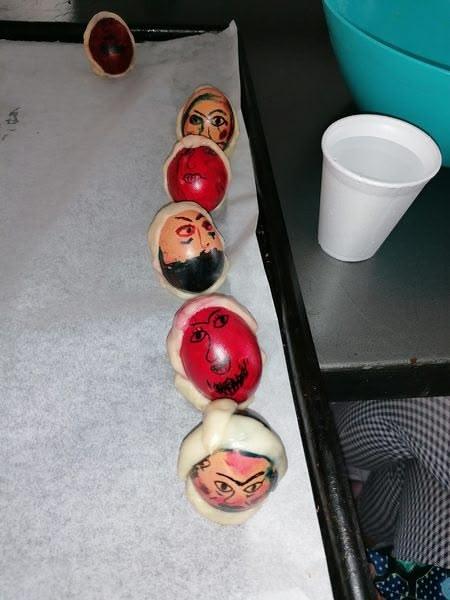
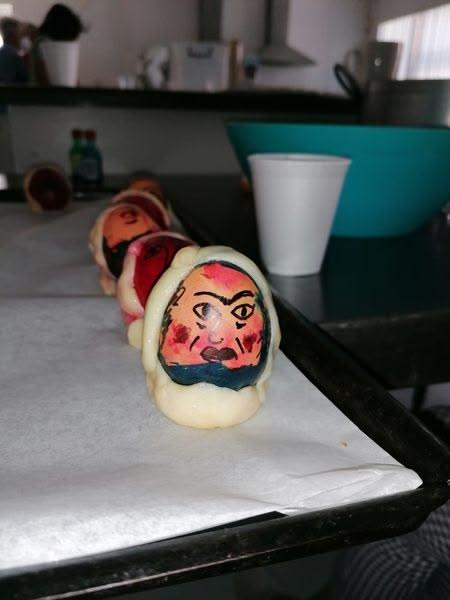
Among Sephardim, the traditional food associated with Purim was foulares. Different Sephardic groups made foulares in different ways. In Rhodes, the most widespread recipe was to make a circle of pastry dough about one-fourth inch thick and two inches in diameter. A hard-boiled egg was placed on this base. Thin strips of dough were then placed over the egg in a criss-cross which was connected to the base. Then the foulares were baked. Among various groups of Sephardim, the foulares are made to symbolize Haman’s foot or ear, or the rope used to punish Haman (by caging him or by hanging him). In Rhodes, it seems that the latter two symbols were intended.
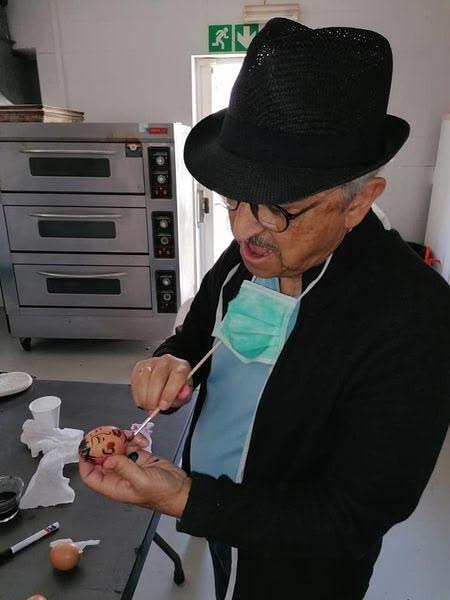
Isaac Habib preparing and painting Foulares – Cape Town 2021
Songs of Purim
One of the favourite Ladino Purim songs is Kuando Haman se embracho, meaning when Haman became drunk.
Additional Resources
One Small Sephardic Pastry Contains the Essence of Purim
Seattle Sephardic Network
Sephardic Purim Gifts of Food
Jewish Journal
The Sephardic Guide: Halakhot and Traditions of Purim
SephardicU
One Small Sephardic Pastry Contains the Essence of Purim
Seattle Sephardic Network
Sephardic Purim Gifts of Food
Jewish Journal
The Sephardic Guide: Halakhot and Traditions of Purim
SephardicU
Sources and References
- Marc Angel, The Jews of Rhodes (1978).
- Extracts from Stella’s Sephardic Kitchen (2012).
- Extract from The Sephardi Culinary Tradition (1984).
- “What is Second Purim?” Chabad of New Jersey. Available at: http://www.chabadnj.org/page.asp?pageID=%7B1F216079-F7B3-4844-88ED-D3ADDE4AB3C2%7D.
- “Second Purim”. Wikipedia. Available at: https://en.wikipedia.org/wiki/Second_Purim#cite_note-ency-5.