
In Sephardic communities there is a tradition of welcoming girls with a celebration called zeved habat, or “gift of the daughter.” The name for the ceremony derives from the book of Genesis, in which the matriarch Leah states, following the birth of Zevulun, “Zevedani Elohim oti zeved tov,” or “God has granted me a gift.” In Ladino this is known as, las fadas or la fijola.
Meaning and Significance
Contents
History
Sephardic prayer books from as early as the seventeenth century record the zeved ha-bat — and some trace it back to medieval Spain. It is believed that Sephardic Jews living in medieval Spain borrowed the term las fadas, meaning “the fairies,” from their Christian neighbours, who believed that fairies were present when babies were born and offered blessings on their arrival. As Sepharadim moved throughout the Ottoman Empire, the ceremony was also sometimes known as la fijola — a form of the word hija, meaning “girl.”
While Sepharadim did not share the Christian belief in fairies, they did adopt the notion that bestowing blessings upon newborns was important. The baby naming ceremony revolved around family members praying for the newborn girl to have a successful future. Many wished her novya ke la veamos (“may we see you as a bride”) a sentiment which, throughout history, defined a woman’s success by her marital status. Another ritual that often took place was known as Las siete kandelas, with seven candles lit – deemed to bring good luck in Jewish mysticism.
Traditionally, the baby is given an amulet symbolic of an open hand, hamsa, and a sprig of rue, aruda, which are placed on the cradle, believed to ward off the evil eye.
The Las Fadas ceremony can take place any time from about a week until about a month after birth.
Rebecca Amato Levy’s reflections on Las fadas as it was practiced in Rhodes
Las fadas
When a daughter was born, the ritual was much simpler. On the first Saturday following the birth, the father went to the synagogue and the congregation sang to the father songs written specifically for this purpose. The baby was not brought to the synagogue.
If the baby girl came from a rich family, they would have an elaborate celebration in the home.
The word fadas is an ancient Spanish word meaning godmother. Today, in Spain, the word has been changed to hadas, which means good fairy godmother. As a rule, the honour of being the godmother was given to a young virgin single girl. She was dressed in white as a bride, with her head covered by a veil. The baby was dressed in a white silk gown with a white silk bonnet. The baby was handed over to the girl, and the rabbi sang and named the baby while the godmother was holding the child. Following the service, everyone was invited to eat, drink and celebrate the fadas.
Las fadas
When a daughter was born, the ritual was much simpler. On the first Saturday following the birth, the father went to the synagogue and the congregation sang to the father songs written specifically for this purpose. The baby was not brought to the synagogue.
If the baby girl came from a rich family, they would have an elaborate celebration in the home.
The word fadas is an ancient Spanish word meaning godmother. Today, in Spain, the word has been changed to hadas, which means good fairy godmother. As a rule, the honour of being the godmother was given to a young virgin single girl. She was dressed in white as a bride, with her head covered by a veil. The baby was dressed in a white silk gown with a white silk bonnet. The baby was handed over to the girl, and the rabbi sang and named the baby while the godmother was holding the child. Following the service, everyone was invited to eat, drink and celebrate the fadas.
Reverend David J. Behar presiding over baby-naming of Rita Franco, daughter of Maurice and Ventura Franco at Congregation Ezra Bessaroth. University of Washington Libraries, Special Collections, JEW0100.
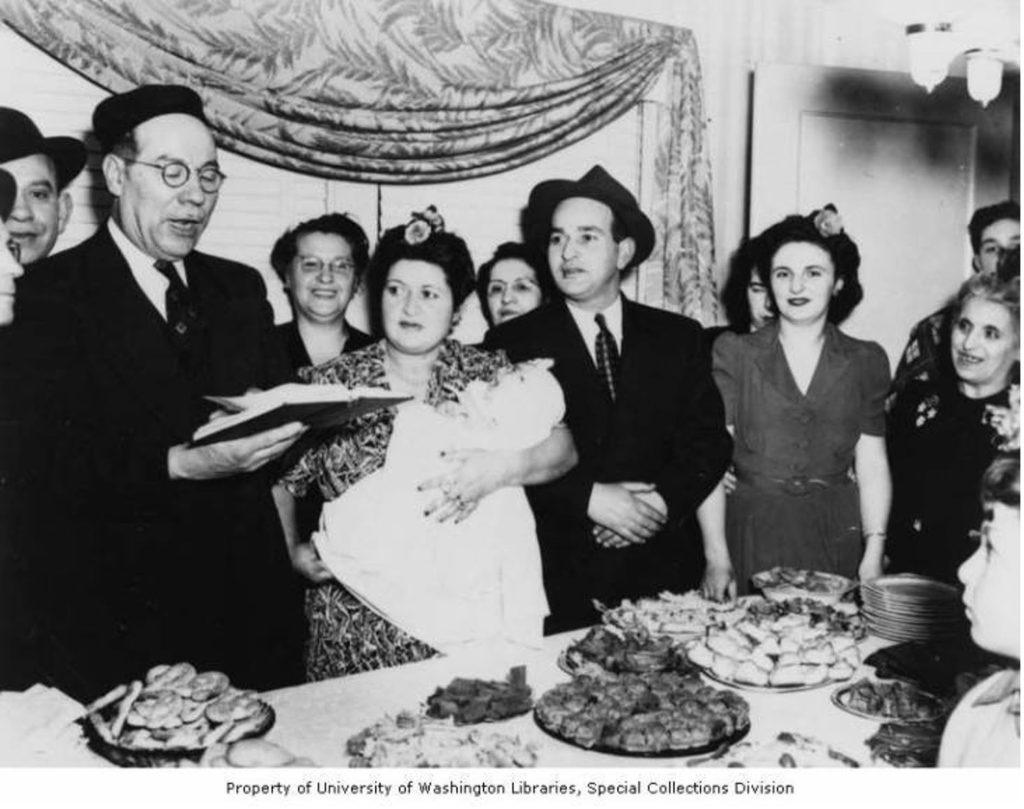
Leading up to the announcement of the baby’s name, portions from Song of Songs — a biblical text about the love between God and the Jewish people written as an allegorical love song — were sung, sometimes in Ladino. The first verse chanted describes a dove emerging from the crevices of a cliff so that others may hear its cooing song — an allusion to the baby girl emerging, for the first time, as a member of the Jewish community:
Mi paloma en reskisyos de la penya en enkuvierta del eskalon azme ver a tu vista azme oir a tu boz ke tu boz savroza i tu vista donoza.
“My dove, in the crevices of the cliff, hidden in the step, let me see your appearance, let me hear your voice; your voice is pleasant and [the] sight [of you] is comely.”
If the family is celebrating their first child at the fijola, an additional verse is sung about the dove being her mother’s only offspring:
Una eya mi paloma mi prenizma una eya a su madre klara eya a la ke la paryo la vieron ijas i la bien aventuraron reyna i donzeyas i la alavaron.
“My dove is one, my perfect [one], the only one of her mother, pure to the one who gave birth to her; daughters, queens, and maidens saw her and praised her.”
Just before announcing the baby’s name, a prayer called the mi she-berakh is said, meaning “He who blessed.” A mi she-berakh prayer is said on many life cycle occasions, including berit mila and pidyon ha-ben, and also near the end of the life cycle if a person falls ill. While the mi-sheberakh often references the Jewish patriarchs — Abraham, Isaac, Jacob, and other important male figures — the mi she-berakh at the fijola mentions the matriarchs and other Jewish heroines, like Miriam (Moses’ sister) and Queen Esther (the heroine of the Purim story), thereby revising a classical prayer to make it more fitting for girls.
מִי שֶׁבֵּרַךְ אִמּוֹתֵינוּ שָׂרָה וְרִבְקָה. רָחֵל וְלֵאָה. וּמִרְיָם הַנְּבִיאָה וַאֲבִיגַיִל. וְאֶסְתֵּר הַמַּלְכָּה בַּת אֲבִיחַיִל. הוּא יְבָרֵךְ אֶת הַיַּלְדָּה הַנְּעִימָה הַזּאת. וְיִקָּרֵא שְׁמָהּ בְּיִשְׂרָאֵל פלונית. בְּמַזַּל טוֹב וּבְשַׁעַת בְּרָכָה. וִיגַדְּלֶהָ בִּבְרִיאוּת שָׁלוֹם וּמְנוּחָה. וִיזַכֶּה לְאָבִיהָ וּלְאִמָּהּ לִרְאוֹת בְּשִׂמְחָתָהּ וּבְחֻפָּתָהּ. בְּבָנִים זְכָרִים. עשֶׁר וְכָבוֹד. דְּשֵׁנִים וְרַעֲנַנִּים יְנוּבוּן בְּשֵׂיבָה. וְכֵן יְהִי רָצוֹן וְנאמַר אָמֵן׃
The one Who blessed our mothers, Sarah and Rivkah, Rachel and Leah, and the prophet Miriam and Abigayil and Queen Esther, daughter of Abichayil — may He bless this beloved girl and let her name in Israel be … [name] with good luck and in a blessed hour; and may she grow up with good health, peace and tranquility; and may her father and her mother merit to see her joy and her wedding, and male children, riches and honour; and may they be vigorous and fresh, fruitful into old age; and so may this be the will, and let it be said, Amen!
Order of The Ceremony
Menu
After the ceremony there is a lavish Kiddush, or festive meal which included sweet treats to celebrate the sweetness of the occasion.
Songs
https://www.youtube.com/watch?v=mHrQ-cPnt4U
Fada De Mi Korazon (Fairy Of My Heart) by: Nani Noam Vazana
The lyrics are sung from a mother’s perspective, to a baby girl.
She blesses & comforts her and calls her “Fairy Of My Heart” (Fada De Mi Korazon).
Videos
https://www.youtube.com/watch?v=j5kWRAREMYw
Home video of a a fijola in Seattle from the 1950s
https://youtu.be/EmvHZEx4Usk
Home video of a Las Fadas from Cape Town 2005
Naming Conventions
In Sephardic custom, naming children after living relatives (as well as deceased ones) is encouraged. A child is named according to an established priority.
The firstborn daughter receives the name of her paternal grandmother and the second-born daughter that of her maternal grandmother. The firstborn daughter is given the title behora.
After happy events, a girl can be named Mazaltov (good luck), Fortuné (good fortune), or Bienvenida (welcome). A daughter could be named after a biblical figure, for example, Rachel, Sara, Miriam or Rebecca.
In times past the names of flowers were also popular, such as Rosa (rose), Flor (flower) or Violetta (violet). Other popular names were Estreya (star), Luna (moon), Sol (sun) or even precious stones; Perla (pearl), Diamante (diamond) or Gioya (jewel). As Rabbi Herbert Dobrinsky states in his book A Treasury of Sephardic Laws and Customs, women do not necessarily have Hebrew names, they may also have Spanish names. The exact name, whether Spanish or Hebrew, is used in the marriage contract or on any other official document.
Sources and References
- Rebecca Amato Levy, I Remember Rhodes (1987).
- Historic Rituals for Welcoming Jewish Daughters.
- “Sephardic Life Cycles – La Fijola”. Jewish Studies, University of Washington. Available at: http://jewishstudies.washington.edu/omeka/exhibits/show/sephardic-life-cycles/la-fijola.
- “Zeved Habat”. Wikipedia. Available at: https://en.wikipedia.org/wiki/Zeved_habat.