
Fundamentally, the bar or bat mitzvah marks the day a boy turns thirteen, or a girl turns twelve, and enters Jewish adulthood. Subsequently, they can participate more fully in Jewish life and its obligations. In Ladino, the occasion is known as kumplir minyan, “to complete the minyan,” which refers to a new obligation young boys can now fulfil as Jewish adults: some prayers require a quorum of ten adult Jewish men, known as a minyan, in order to be said; thus the phrase kumplir minyan refers to a young boy being counted within that quorum.
Meaning and Significance
Contents
History
In 1950s Istanbul, an enhanced bar mitzvah becomes the new standard
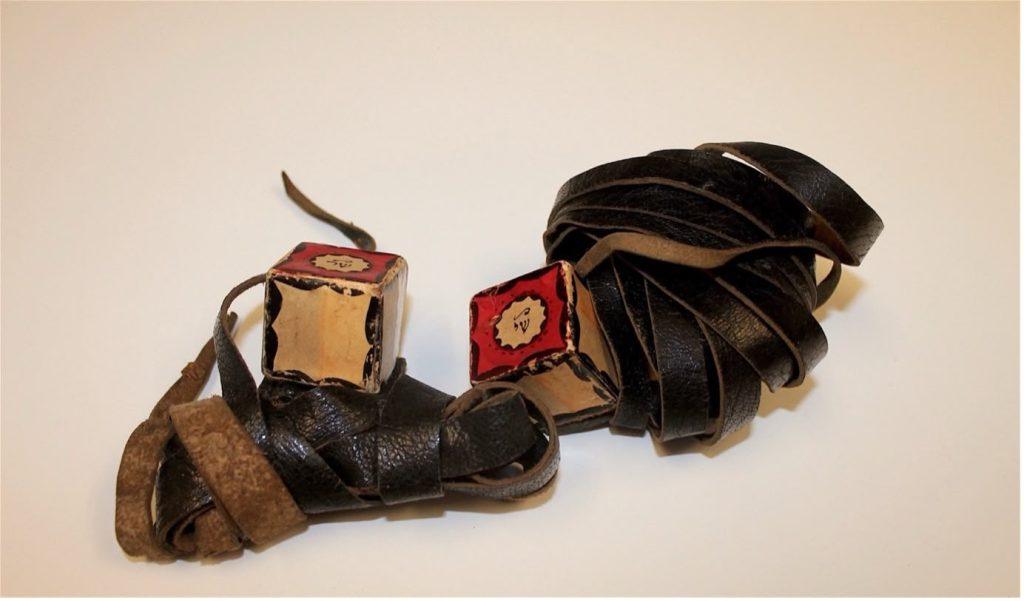
In Nisim Behar’s El gid para el pratikante (Istanbul, 1957), his guide to Jewish law and Sephardic customs, we can see the bar mitzvah emerging as the modern ceremony that we know today. Behar mentions that a bar mitzvah boy will not only mark the day by donning tefilin, or phylacteries, for the first time (only Jewish adults can wear tefilin during prayer) — a moment that could easily pass by unceremoniously — but that the young boy will also read the coinciding weekly portion from a Torah scroll, deliver a speech, and enjoy a party with family and friends:
El Dia de Bar-Mitzvah se veste Tefilin, i si es lunes o cueves suve al Sefer-Torah…Si el ijiko aze Derasa (deskorso), la Seuda se konta komo Tseudat-Mitzvah, mezmo ke akel dia no es el dia de Bar-Mitzvah.
“On the day of the Bar Mitzvah the boy wears tefilin [phylacteries], and if it is Monday or Thursday, he will go up [receive an aliya] to the Torah [which is only read Monday, Thursday, and Shabbat]…The son gives a derasha [speech], the seuda [meal] is counted as seudat mitzvah [festive meal], even if that day is not his actual bar mitzvah.”
If we go back in time several decades, however, we discover not only that the bar mitzvah lacked much of the ceremonial aspects that it would later acquire, but that for Sephardic communities, there was little celebration at all — and certainly no speech.
Rebecca Amato Levy’s reflections on Bar Mitvah as it was practiced in Rhodes
The Bar Mitzvah was celebrated in Rhodes on either a Monday or a Thursday morning when the boy donned the Tefilin. These were the days that the service included the Torah reading. The following Saturday, the Bar Mitzvah boy read the Perasha, or portion of the Torah for the day.
As far as glamorous parties or elaborate celebrations were concerned—there were none. The wealthy would prepare dinner at home for the family and prepare Kupetas de Susam (sesame candy) to pass out at the synagogue. On the other hand, the poor would pass out likoum.
There were never Bat Mitzvah celebrations in Rhodes.
The Bar Mitzvah was celebrated in Rhodes on either a Monday or a Thursday morning when the boy donned the Tefilin. These were the days that the service included the Torah reading. The following Saturday, the Bar Mitzvah boy read the Perasha, or portion of the Torah for the day.
As far as glamorous parties or elaborate celebrations were concerned—there were none. The wealthy would prepare dinner at home for the family and prepare Kupetas de Susam (sesame candy) to pass out at the synagogue. On the other hand, the poor would pass out likoum.
There were never Bat Mitzvah celebrations in Rhodes.
Order of the ceremony
The tefillin ceremony would take place at the Shacarit (morning) prayer service when the other men in the community put on their tefillin (phylacteries) and the bar mitzvah would join them.
Blessings
An illustrated guide to putting on tefillin and the blessings (including audio) can be found here.
Menu
When the Rhodesli’s went to Rhodesia, they adopted the custom of the Ashkenazi Jews (as did other Sephardim around the world) and had a celebratory meal in the synagogue on the day of the ‘tefillin ceremony’. Because the tefillin ceremony is held early in the morning at the shacharit service, a celebratory dairy breakfast, desayuno was served after the service which included an array of savoury pastries, vegetable bakes, festive bread rolls and reshikas, accompanied by a variety of cheeses and olives. A choice of marzipan-based sweets, rice and rose water-scented puddings, fruit preserves and a full repertoire of cakes, sweet pastries and biscuits were shared with family and friends. On the Shabbat, a portion of the Torah, the Perasha, was read followed by great festivities for the rest of that day. (Stella’s Sephardic Kitchen)
Specific Conventions Relating to This Event
The special blessing made on congratulating the bar mitzvah boy is Novio ke te veygamos en vida de padre i madre i todos justos i sauldosos, “May we see you as a groom with your father and mother and everyone in the family healthy and well.”
Bat Mitzvah
Bat mitzvah’s were not celebrated in Rhodes. Subsequently as a result of changing times, batmitzvah’s are celebrated in South Africa, based on guidance from the Rabbi and the current conventions.
Mattie Hasson recounts not having a Bat Mitzva in Rhodesia – video clip
https://youtu.be/8_KUjmmx6Wc
Ricca Israel recounts her Bat Mitzvah in the Congo in her interview – video clip
https://youtu.be/pheUuHPYAQk
References
- Marc D. Angel, The Jews of Rhodes.
- Stella Hanan Cohen, Stella’s Sephardic Table (2012).
- Rebecca Amato Levy, I Remember Rhodes (1987).